
Espionage is a contest for information, access and advantage. Its public numbers reveal only part of the story. Follow the institutions and their resources, the people who provide secrets, the changing targets of collection, and the ways operations are exposed.
Source periods differ: US budgets to FY2026; the Chinese case series through 2022; cyber records through 2023; the historical American study covers activity beginning in 1947–2015. Each chart states its coverage.
Statistics
- The institutions behind the intelligence world
- The money behind the mission
- Volunteers were more common than recruited spies
- Who received—or was offered—American secrets?
- Reported Chinese espionage directed at the United States
- The growing public record of cyberespionage
- Where cyberespionage targets appear
- What spies target online
- How espionage came to light
- The lives behind the memorial
- Major intelligence agencies
1. The institutions behind the intelligence world
Selected intelligence agencies · founding or institutional lineage year
Modern intelligence institutions grew around different political shocks. Britain’s domestic and foreign services share a 1909 origin, while several agencies in this selection emerged during the early Cold War. Later dates often reflect reorganisation rather than the invention of espionage: France’s DGSE inherited an older service, and Russia’s SVR and FSB followed the Soviet collapse. The useful distinction is between institutional continuity and a new name or legal framework. A younger agency can inherit experienced personnel, networks and methods. These dates therefore help explain the architecture of intelligence, but they do not establish which country began spying first or which service is most capable.
Years follow the founding conventions in the linked histories. GCHQ uses its 1919 predecessor; DGSE and FSB use their present institutional form. This is a selection, not a complete world inventory.
2. The money behind the mission
US National and Military Intelligence Programs · fiscal years 2007–2026
The combined US intelligence appropriation rose from $63.5 billion in 2007 to $109.0 billion in 2026, an increase of about 72% in nominal dollars. That rise was not continuous: funding fell after 2010, recovered later in the decade and dropped again in 2025 before rebounding. The National Intelligence Program accounts for most of the total throughout. These large commitments show how intelligence depends on permanent institutions, specialist staff and technical systems, not just individual agents. The 2013 fall also reflects sequestration. Inflation absorbs part of the long-run increase, so the growth in purchasing power is smaller than the headline dollar change.
Appropriations, not actual outlays or agency budgets; current US dollars, not inflation adjusted. Includes intelligence activities beyond espionage. The 2013 amounts are after sequestration. FY2026 figures come from the October 2026 releases.
Source: ODNI archived intelligence budget table, 2007–2025 · ODNI, FY2026 NIP appropriation: $78.1 billion (30 October 2026) · FY2026 MIP release: $30.9 billion (30 October 2026), reproduced by Mirage News.
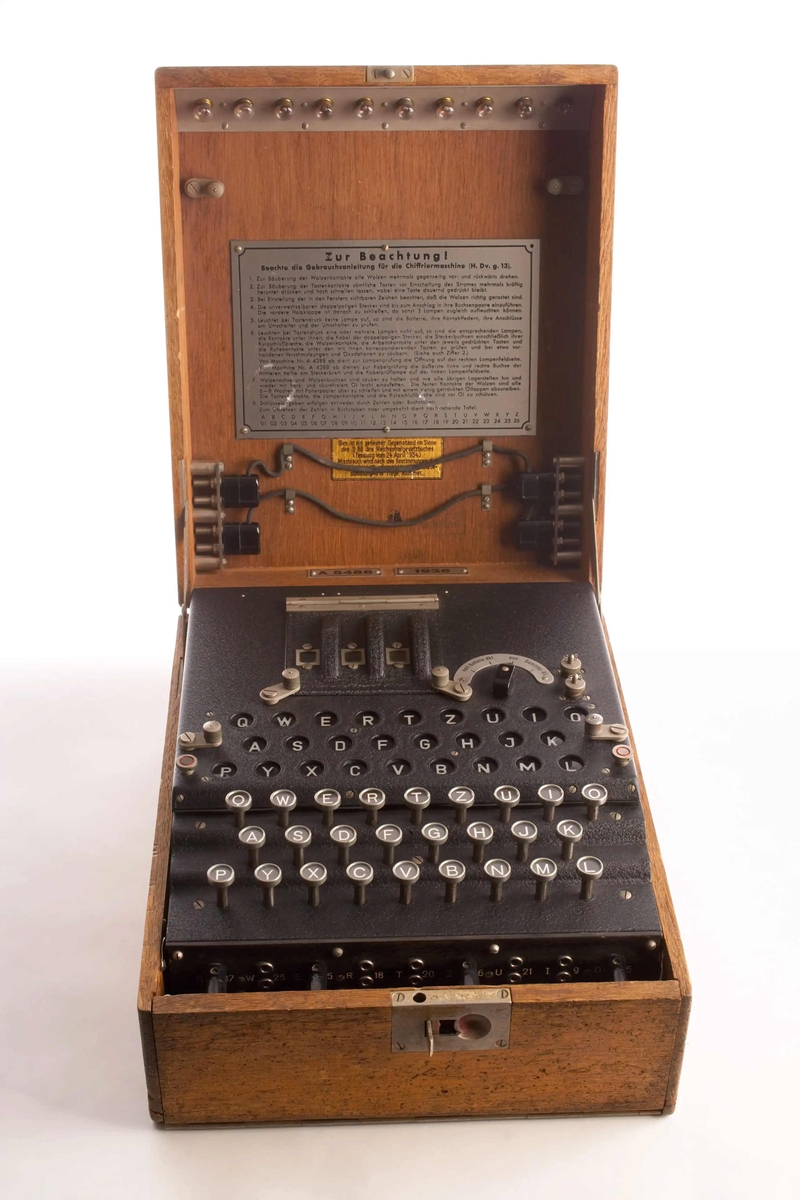
Secrets travel through systems—and people
The Enigma machine is a reminder that intelligence has long combined technical collection with human knowledge. Intercepting a message is only one step: someone must make sense of it, judge whether it is reliable and connect it to a decision. The same broad problem runs through modern espionage, even as communications move from radio traffic to digital networks. Computers can expand the volume of information available, but access, interpretation and trust still matter. That is why the story moves from the resources of intelligence institutions to the people who choose—or are persuaded—to provide information. Neither the machine nor the individual explains the whole system.
Photo: CIA / CIA Museum · public domain
3. Volunteers were more common than recruited spies
Documented American espionage cases · activity began 1947–2015
Recruitment is only one route into espionage. In every cohort here, more people volunteered than were recruited, with volunteers making up roughly two-thirds of the 1980s group. The later cohort still has a clear volunteer majority. That pattern challenges the idea that every case starts with a foreign intelligence officer patiently cultivating a target. Some insiders take the initiative themselves, bringing access or information to a potential buyer. The finding also changes the prevention question: organisations must consider why someone with legitimate access might decide to offer it elsewhere. The balance describes discovered historical cases, however; it cannot reveal the entry routes of spies who remained undetected.
PERSEREC Table 6. Known entry route for 207 of 209 individuals: cohort denominators 67, 74 and 66. Cohorts have unequal durations. Includes the report’s broader case definition, not only convictions. Percentages calculated from published counts.
Source: PERSEREC, The Expanding Spectrum of Espionage by Americans, 1947–2015 (2017), Tables 6 and 8.
4. Who received—or was offered—American secrets?
PERSEREC recipient regions and groups · three activity-start cohorts
The Cold War’s imprint is unmistakable: the Soviet Union and Russia dominate the first two cohorts, alongside other Eastern Bloc recipients. After 1990, the recorded destinations become more varied. Asia and Southeast Asia lead the recent cohort, while the Middle East and Central or South America take larger roles. This is consistent with a world in which intelligence competition extends beyond a single superpower rivalry. The change is also partly about what enters the record: the study includes attempts, public disclosures and non-state recipients. It is therefore evidence of a broader range of documented destinations, not a direct measure of how much information each government obtained.
PERSEREC Table 6: 69, 80 and 77 recipient relationships by cohort, totalling 226. One person can have several recipients. Source categories mix regions, countries, a non-state group and public release; they are retained explicitly rather than relabelled as countries.
Source: PERSEREC, The Expanding Spectrum of Espionage by Americans, 1947–2015 (2017), Tables 6 and 8.
5. Reported Chinese espionage directed at the United States
Published CSIS annual totals · 2001–2022
The published record becomes much denser in the late 2010s, reaching 26 cases in 2020 compared with low single-digit totals near the beginning of the series. The sharp 2016 dip follows the 2015 US–China agreement on commercial cyberespionage, but the subsequent rebound makes a lasting reduction difficult to infer. Strategic technology and commercial knowledge can serve overlapping goals, helping explain why espionage reaches beyond military facilities. Public cases also reflect investigative priorities and disclosure decisions. A rise in reports may therefore combine more activity, better detection and greater willingness to name suspects. These figures describe reported cases; they are not counts of convictions or all Chinese intelligence operations.
CSIS March 2023 survey, published “Total espionage cases” figure: 223 cases in 2001–2022. The text also includes a February 2023 balloon entry; partial 2023 is omitted. Annual totals are transcribed from the published chart. Its 2020 total differs by one from the dated narrative list; the series follows the figure consistently.
Source: Center for Strategic and International Studies, March 2023 survey (PDF; annual chart on page 2).
6. The growing public record of cyberespionage
Matched CFR incident records · year first reported, 2005–2023
The public record expands sharply after the mid-2010s. In this matched catalogue, annual incidents rise from 14 in 2015 to 110 in 2022, before easing to 97 in 2023. Digital networks make a single operation capable of reaching many organisations and countries, while security researchers and public agencies expose campaigns that might previously have remained obscure. Both developments can enlarge the visible record. The lower 2023 count does not by itself establish a retreat in espionage: discovery and disclosure can lag behind the operation. The strongest conclusion is that cyberespionage became far more prominent in the documented record, rather than that this catalogue captures its full scale.
CFR timeline joined to the public filter metadata; 563 matched records labelled both Incident and Espionage, 2005–2023. Threat-actor profiles are excluded. Nine metadata entries do not join to the timeline and are excluded; 11 matched 2024 records are omitted because that year’s coverage is incomplete. Zero means no matched record, not no espionage.
Source: Council on Foreign Relations, Cyber Operations Tracker · CFR public timeline filter metadata.
7. Where cyberespionage targets appear
Named target countries and territories · the same CFR incident set
563 incidents; 99 have no named country or territory. One incident can have several targets. Small locations are shown as dots; boundaries imply no position on sovereignty.
The United States appears most often, with 131 incidents naming it as a target, followed by Ukraine with 45 and South Korea with 43. These locations combine valuable information with strategic competition, although the map alone cannot isolate the reasons for each operation. The distribution also reflects whose incidents are investigated and publicly reported. Prominent countries can attract both more espionage and more scrutiny. Multi-country campaigns matter too: one operation may reach targets across several borders. The resulting pattern is a map of documented attention, not a league table of vulnerability, and the 99 incidents without a named location leave part of that geography unseen.
Count of unique incident–target-location pairs; multiple locations per incident are allowed. Locations follow CFR’s labels. The accessible table includes small territories. Natural Earth outlines are for orientation and imply no view on sovereignty.
Source: Council on Foreign Relations, Cyber Operations Tracker · CFR public timeline filter metadata · Natural Earth country outlines, public domain.
8. What spies target online
Broad target categories and attributed sponsors · CFR, 2005–2023
Government is the most frequently recorded target category, but the private sector and civil society also appear repeatedly. That breadth matters: valuable intelligence is held by companies, researchers, campaigners and community organisations as well as ministries. Commercial systems can contain strategic technology or provide access to other organisations; civil society can hold information about political networks and people a state wishes to monitor. The categories overlap because campaigns can pursue several kinds of target. A smaller military total should not be read as evidence that defence secrets matter less: public disclosure, the source’s category rules and the secrecy surrounding military networks all shape the visible balance.
Government 263; private sector 218; civil society 180; military 54 category mentions. An incident may occur in several categories. Sponsors follow CFR’s public attribution. Single-sponsor records form the named groups; all other, multiple or unspecified sponsors are grouped together.
Source: Council on Foreign Relations, Cyber Operations Tracker · CFR public timeline filter metadata.
9. How espionage came to light
Known detection methods in documented American cases · 1947–2015
Surveillance and tips dominate the recorded methods, accounting for 154 of the 258 mentions across the three cohorts. Their prominence shows the continuing importance of observation and information supplied by people around an investigation. Confessions, telephone taps and offers to sell information also appear, but less often. A useful implication is that exposure need not begin with a dramatic technological breakthrough; a concern raised by another person can be an important lead. These counts cannot tell us which method is most effective. They describe what was recorded in discovered cases, with more than one method sometimes contributing to the exposure of the same person.
PERSEREC Table 8. Unit is method mentions, not individuals: 66, 85 and 107 by cohort. “Offer for sale” is 2 + 8 + 8 = 18. Multiple methods can be recorded for one person. This is not a comparison of detection success rates.
Source: PERSEREC, The Expanding Spectrum of Espionage by Americans, 1947–2015 (2017), Tables 6 and 8.

Recognition can arrive decades later
The CIA Memorial Wall shown here was photographed with 140 stars in 2024. A star commemorates a person, but the circumstances of that person’s service may remain concealed. The timing of recognition can also differ from the timing of death: in 2023 the agency added a star for physician Jon Evans, who died in 1969. This makes the wall both a memorial and a reminder of the limits of public knowledge. Counting newly added stars as deaths in that year would distort the history. The following chart instead uses publicly reported death dates and keeps undisclosed years separate.
Photo: CIA / CIA Museum · public domain
10. The lives behind the memorial
Publicly reported death decades of CIA Memorial Wall honorees
The 1960s contain the largest number of publicly dated deaths in this memorial listing, followed by the 1980s and 2000s. Those concentrations connect the human cost of intelligence to periods of intense overseas activity, but individual events can also shape a decade: aircraft losses, bombings and attacks have killed several people at once. The memorial includes varied duties and circumstances, so its honorees should not all be described as agents killed by adversaries. Secrecy continues after death, leaving nine years undisclosed in the compiled table. The quieter recent bars therefore cannot establish that intelligence work has become safer, especially while the 2020s remain incomplete.
Aggregation of the publicly reported memorial table (retrieved 16 November 2026), checked against the CIA director’s June 2026 statement of 141 stars. 132 honorees have reported death years; nine are undisclosed. Some names and dates are publicly reported rather than officially declassified. Year of death is different from year of commemoration.
Source: CIA Memorial Wall: public list of reported death dates, Wikipedia (secondary compilation) · CIA director’s June 2026 remarks, published July 2026: 141 memorial stars.
11. Major intelligence agencies
Table 2 · A selected institutional guide, not a ranking of effectiveness
16 agencies
| MI5 | United Kingdom | 1909 | Domestic security | Secret Service Bureau; home branch | — |
|---|---|---|---|---|---|
| MI6 / SIS | United Kingdom | 1909 | Foreign intelligence | Secret Service Bureau; foreign branch | — |
| GCHQ | United Kingdom | 1919 | Signals intelligence | GC&CS founded 1919; GCHQ name from 1946 | — |
| CIA | United States | 1947 | Foreign intelligence | Central Intelligence Group preceded CIA | No agency figure supplied; combined US programs shown above |
| ASIO | Australia | 1949 | Domestic security | Founded by executive charter | — |
| Mossad | Israel | 1949 | Foreign intelligence | Coordinating institute; reorganised in 1951 | — |
| ASIS | Australia | 1952 | Foreign intelligence | Established by executive decision | — |
| NSA | United States | 1952 | Signals intelligence | Armed Forces Security Agency predecessor | No agency figure supplied; combined US programs shown above |
| BND | Germany | 1956 | Foreign intelligence | Gehlen Organisation predecessor | — |
| DIA | United States | 1961 | Military intelligence | Consolidated defence intelligence functions | No agency figure supplied; combined US programs shown above |
| R&AW | India | 1968 | Foreign intelligence | Separated from the Intelligence Bureau | — |
| DGSE | France | 1982 | Foreign intelligence | Succeeded SDECE | — |
| MSS | China | 1983 | State security | Combined intelligence and counterintelligence functions | — |
| CSIS | Canada | 1984 | Security intelligence | Succeeded the RCMP Security Service | C$813.0m; 2024–25 expenditure |
| SVR | Russia | 1991 | Foreign intelligence | Post-Soviet foreign intelligence service | — |
| FSB | Russia | 1995 | Domestic security | Replaced the Federal Counterintelligence Service | — |
Agency names can conceal very different responsibilities. Some services concentrate on foreign intelligence, others on domestic security, military intelligence or intercepted communications. Founding dates also follow different institutional conventions, especially where a predecessor continued under a new name. The table is intended as a guide to those distinctions. Budget transparency varies, and the selected disclosure here is not a comparable international spending series.
Agency names link to histories or institutional sources. “—” means no agency-specific budget figure is supplied here, not zero spending or a claim that no public figure exists. Canada’s figure is rounded from C$813,017,414. US program totals cannot be assigned to individual agencies. Remits are broad descriptions, not a complete statement of legal powers.
Other pages
European UnionRussia–Ukraine war
Sources and image credits
Sources accessed 16 November 2026. Periods vary; historical studies and catalogue snapshots are not current global totals.
- PERSEREC, The Expanding Spectrum of Espionage by Americans, 1947–2015 (2017), Tables 6 and 8
- ODNI archived intelligence budget table, 2007–2025
- ODNI, FY2026 NIP appropriation: $78.1 billion (30 October 2026)
- FY2026 MIP release: $30.9 billion (30 October 2026), reproduced by Mirage News
- Center for Strategic and International Studies, March 2023 survey (PDF; annual chart on page 2)
- Council on Foreign Relations, Cyber Operations Tracker
- CFR public timeline filter metadata
- CIA Memorial Wall: public list of reported death dates, Wikipedia (secondary compilation)
- CIA director’s June 2026 remarks, published July 2026: 141 memorial stars
- Natural Earth country outlines, public domain
- Canada, 2026–27 Main Estimates: CSIS historical 2024–25 expenditure, Table 98
- Agency history sources: links in the reference table above.
Banner: Headquarters of MI6 – Secret Intelligence Service, Vauxhall, London by Charles (usf1fan2), 30 August 2023. CC BY 2.0. The preview uses a display crop and dark overlay; the source photograph is unmodified.
Body photographs: Enigma machine, CIA Museum and CIA Memorial Wall, 2024. Public domain under the CIA site policy where no separate copyright is indicated. Photographs illustrate the subject and do not imply endorsement.
Memorial date aggregation uses factual dates from the Wikipedia memorial listing; no biographical prose has been reproduced. Charts, page design and analysis: The World in Stats.