
INTRODUCTION
The Nobel peace prize is one of the most prestigious and sought after awards in the world. It is the most well known of the Nobel prizes and it’s winners are elevated to unique place in history. The following charts show the distribution of Nobel prize winners by occupational category and by period.
Charts
1. Nobel Peace Prize Winners by Occupation
2. Nobel Peace Prize Winners by Occupation and Period
3. Nobel Peace Prize Laureates by Country
This chart shows the occupations of Nobel Peace Prize winners, highlighting the types of roles most commonly associated with contributions to peace. Politicians and diplomats make up the largest group, accounting for about 40.5% of winners. This is not surprising, as individuals in these positions often have the power to negotiate treaties, resolve conflicts, and influence international relations, allowing them to directly shape peace agreements and political settlements.
The second largest category is activists, who represent 17.1% of winners. Many of these individuals are peace activists or human rights campaigners who work to promote non-violence, social justice, and civil rights. Their work often involves mobilizing public opinion or drawing global attention to conflicts and injustices.
Other occupations appear less frequently but still play important roles. Clergy and religious leaders, legal professionals, writers and journalists, and educators have all received the prize. These professions often provide platforms to advocate for peace, influence public debate, or promote reconciliation.
It is also important to note that many laureates have had multiple roles during their careers, which explains why several different professions appear across the list.
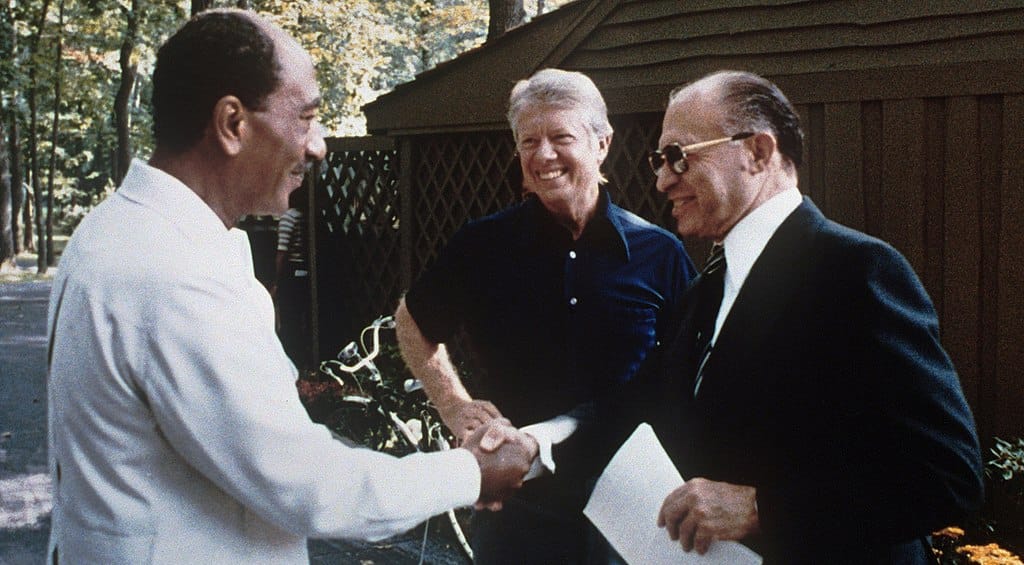
Anwar Sadat, Jimmy Carter and Menachem Begin are all winners of the Nobel peace prize. Sadat and Begin won in 1978 for the Camp David Agreement which President Carter helped to broker. Carter won in 2002 for decades of efforts towards peace.
Prior to World War II, more lawyers and judges won the Nobel Peace Prize than after. During the cold war, far more clergymen won the award than before or since. In all periods, politicians and diplomats won far more than any other group. After, the cold war a large proportion was won by people who were solely or mainly activists. Activists won many before including 3 of the first 4 but they tended to have other occupations such as being teachers, journalist, lawyers, clergymen and others.
This chart shows the countries with the highest number of Nobel Peace Prize laureates. The United States leads by a significant margin, with more than 20 winners. This partly reflects the country’s global political influence and its central role in many international diplomatic efforts, peace negotiations, and humanitarian initiatives during the twentieth and twenty-first centuries. American presidents such as Theodore Roosevelt and Barack Obama are among the most well-known recipients.
The United Kingdom and Switzerland also have a high number of laureates. Switzerland’s strong presence is notable because it is a relatively small country, but it hosts many international organisations in Geneva and has long been associated with diplomacy and humanitarian work, including the International Committee of the Red Cross.
The chart also includes prizes awarded to international bodies such as the United Nations and the League of Nations. Other countries with several laureates include France, Sweden, Belgium, Germany, South Africa, and Russia. Overall, the distribution reflects the importance of diplomacy, international institutions, and global political influence in the awarding of the Nobel Peace Prize.
The chart highlights just how unusually young some Nobel Peace Prize laureates have been when receiving the award. Malala Yousafzai stands out by a considerable margin, becoming the youngest-ever Nobel laureate at just 17 years old when she received the Peace Prize in 2014. Her award recognised her advocacy for girls’ education and her opposition to the suppression of children and young people. Nadia Murad follows at 25, while Tawakkol Karman and several other laureates received the prize in their early thirties.
The list also includes several figures who became internationally recognised for major political or human-rights movements at relatively young ages. Martin Luther King Jr., for example, was only 35 when he received the 1964 Peace Prize for his leadership in the American civil-rights movement. Lech Wałęsa, who later became President of Poland, was 40 when he won in recognition of his role in the Polish Solidarity movement. Overall, the chart demonstrates that the Nobel Peace Prize has occasionally recognised individuals while they were still remarkably young, particularly when their activism had already achieved international significance.
The chart shows a clear long-term shift in the gender distribution of Nobel Peace Prize winners. From 1901 to 1925, men overwhelmingly dominated the category, with roughly 23 male laureates compared with only a small number of women and organisations. Women remained a relatively small minority through much of the twentieth century, although their representation gradually increased. By 1976–2000, women accounted for around seven of the 33 laureates shown, while organisations also became an increasingly significant part of the awards.
The most striking change appears in the 2001–2025 period. Although men still make up the largest individual category, their share has fallen substantially, while women and organisations together account for more than half of the total. This reflects the Nobel Committee’s increasing recognition of women’s roles in peacebuilding, human rights and political activism. Figures such as Malala Yousafzai, Nadia Murad and Leymah Gbowee illustrate this broader shift. The growing presence of organisations also reflects the Peace Prize’s emphasis on collective efforts rather than solely individual political leaders.
OTHER PAGES ABOUT NOBEL PRIZES AND WORLD AFFAIRS
Sources:
charts created using openoffice calc