
INTRODUCTION
The United States of America leads the world in the number of elite universities. This page shows statistics about American universities including regional distribution of the best universities, the ranking of the best universities and other interesting facts.
Statistics
1. Regional Distribution of Top 25 American Universities in 2026 (Pie Chart)
2. States with Most Universities among Top 50 American Universities in 2026 (Bar Chart)
3. Times Higher Education Rankings of American Universities by Score in 2026 (Bar Chart)
4. Largest Public Universities in the USA by Enrollments 2024/2025 (Bar Chart)
5. Ivy League Enrollment by Race for Domestic Students (Stacked Column Chart)
This chart shows the regional distribution of the top 25 American universities in 2026, with the Northeast United States and Midwestern United States jointly leading despite their smaller shares of the national population. The Northeast in particular has historically dominated elite higher education in the United States and, until recently, was usually the clear leader.
By contrast, the Southern United States has the lowest share despite being the country’s largest region by population, containing roughly 38% of Americans. This historical imbalance partly traces back to the South’s past as a plantation-based economy, where wealth and social structures were less conducive to the development of major research universities compared to the more commercial and industrial Northeast.
Meanwhile, the strong showing of the West reflects the rise of California and the growth of major research institutions during the 20th century. Overall, the chart reflects deep historical patterns in American economic and educational development.
This chart shows the concentration of elite universities in a relatively small number of U.S. states. California clearly dominates with nine universities among the top 50 American universities in 2026, reflecting both its enormous population and its position as a global centre for technology, research, and innovation. Institutions such as Stanford University and the University of California, Berkeley system contribute significantly to this dominance.
Smaller northeastern states also perform extremely strongly. Massachusetts, despite its relatively small population, rivals much larger states due to the presence of world-renowned institutions like Harvard University and Massachusetts Institute of Technology.
The chart highlights the historical concentration of academic prestige in coastal and economically advanced regions, particularly the Northeast and California. At the same time, growing states such as Texas are increasingly represented, reflecting shifts in population and investment in higher education.
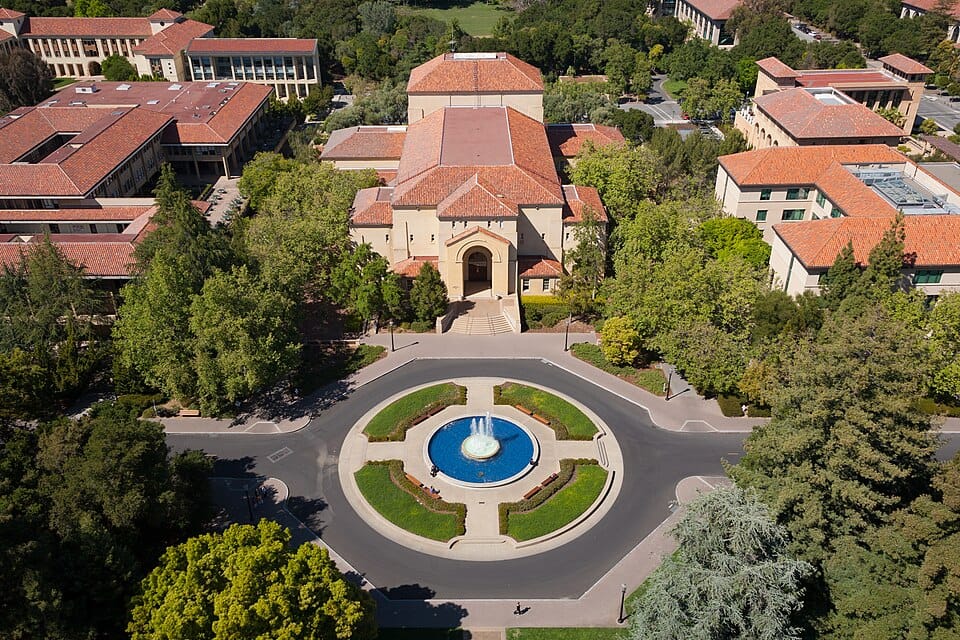
Stanford University is a prestigious private research university located in Stanford, near Silicon Valley. Founded in 1885, it is known for its strong emphasis on innovation, entrepreneurship, and academic excellence. Stanford has played a major role in the development of the technology industry, with many leading companies founded by its alumni. The university offers a wide range of programs across science, engineering, business, and the humanities. Its large campus, renowned faculty, and cutting-edge research facilities make it one of the top-ranked universities in the world.
Image: View of Stanford University campus from Hoover Tower
This chart highlights the continued dominance of elite American universities in global higher education rankings. Massachusetts Institute of Technology leads the group with the highest score, closely followed by institutions such as Princeton University, Harvard University, and Stanford University. The scores are extremely close, showing how competitive the top tier of U.S. higher education has become.
A notable feature is the strong representation of both private Ivy League universities and major research-focused institutions, particularly those with strengths in science, engineering, and medicine. Universities such as California Institute of Technology and Johns Hopkins University are globally influential despite being smaller in size than many public universities.
Overall, the chart reflects the enormous research funding, academic prestige, and international influence of the American university system, which continues to dominate global rankings despite growing competition from Asia and Europe.
This chart highlights the enormous scale of major public universities in the United States, with several institutions enrolling well over 50,000 students. Texas A&M University leads the list, followed closely by University of Central Florida and Ohio State University. These universities function almost like small cities, with extensive campuses, research facilities, sports programs, and student services.
A notable feature is the strong representation of universities from large and fast-growing states such as Texas and Florida. Population growth and expanding demand for higher education have contributed to extremely large student bodies in these states.
Unlike many elite private universities, these public institutions are designed to educate very large numbers of students while maintaining relatively broad access. Many also combine mass undergraduate education with major research activity, making them central to the American higher education system.
Overall, the chart reflects both the scale and accessibility of public higher education in the United States.
This chart shows the racial composition of domestic students across Ivy League universities and highlights both diversity and uneven representation among groups. White students remain the largest group at most institutions, but Asian students are very substantially overrepresented relative to their share of the overall U.S. population. This reflects a combination of high academic attainment, strong representation in competitive admissions pipelines, and concentration in regions with large Asian-American populations.
At the same time, Ivy League universities are generally more racially diverse than much of the country’s higher education system overall. Hispanic/Latino and Black student representation is significant across most schools, even if still below their national population shares.
One reason for this diversity is the exceptional prestige and visibility of Ivy League institutions. Because these universities are seen as national elite institutions, there has long been greater public pressure and institutional focus on creating racially diverse student bodies through outreach, financial aid, and admissions policies.
Overall, the chart reflects both the diversity and the continuing debates surrounding representation and admissions at elite American universities.
.
OTHER PAGES ABOUT SCIENCE AND ACADEMICS
Sources:
Best universities in the United States 2026 – US College Rankings
Ivy League Enrollment Demographics | Ivy Coach
List of United States public university campuses by enrollment – Wikipedia
Image of Stanford University by King of Hearts – Licensed Under Creative Commons Attribution-Share Alike 3.0
Banner Image by King of Hearts – Licensed Under Creative Commons Attribution-Share Alike 3.0