
INTRODUCTION
The NBA is the ultimate competition in basketball. Virtually all the greatest basketball players in history have played in the NBA. In NBA, the MVP (Most Valuable Player) is considered to be the best player of the season. The award was first given for the 1955-1956 season. The regional distribution of origin, the most common state of birth and the distribution by race of the best players shows how widespread and seriously the sport is played in a particular place and community since a greater talent pool tends to produce more great players in any sport. The distribution of the award by position shows the importance of each position to a team and varies over time depending on how strategies have evolved. Unlike American football, there is no one position in basketball which is considered of far greater importance than any other position.
Statistics
1. NBA MVP Awards by Position (%) (Pie Chart)
2. NBA MVP Awards by Position by Decade (Stacked Column Chart)
3. Race by Period of Birth of NBA MVPs (Stacked Column Chart)
4. Most Common State of Birth of MVP Winners (Bar Chart)
5. Tallest and Shortest NBA MVPs (Bar Chart)
6. Players with Most MVPs by Team (Stacked Bar Chart)
7. Top 10 NBA Players by Points Made Over Career (Ranking Chart)
8. NBA MVPs by Position, Place of Birth, Height and Racial Group (Data Table)
This chart highlights the overall historical dominance of centers in winning NBA MVP awards. Nearly 40% of all MVPs have gone to players at the center position, far more than any other role. This reflects how influential dominant big men were in shaping the league, especially during the NBA’s early decades. Legendary centers such as Bill Russell, Wilt Chamberlain, and Kareem Abdul-Jabbar defined entire eras of basketball through scoring, rebounding, and defensive dominance. Their success helped establish the center as the league’s most prestigious position for much of NBA history.
Other positions, particularly point guards and power forwards, still account for significant shares of MVP awards, showing how the game gradually diversified over time. More recently, the center position has experienced a revival through players like Nikola Jokić, whose all-around playmaking and scoring ability have modernized the traditional role of the big man. The chart therefore reflects both historical continuity and the evolution of basketball strategy across different eras.
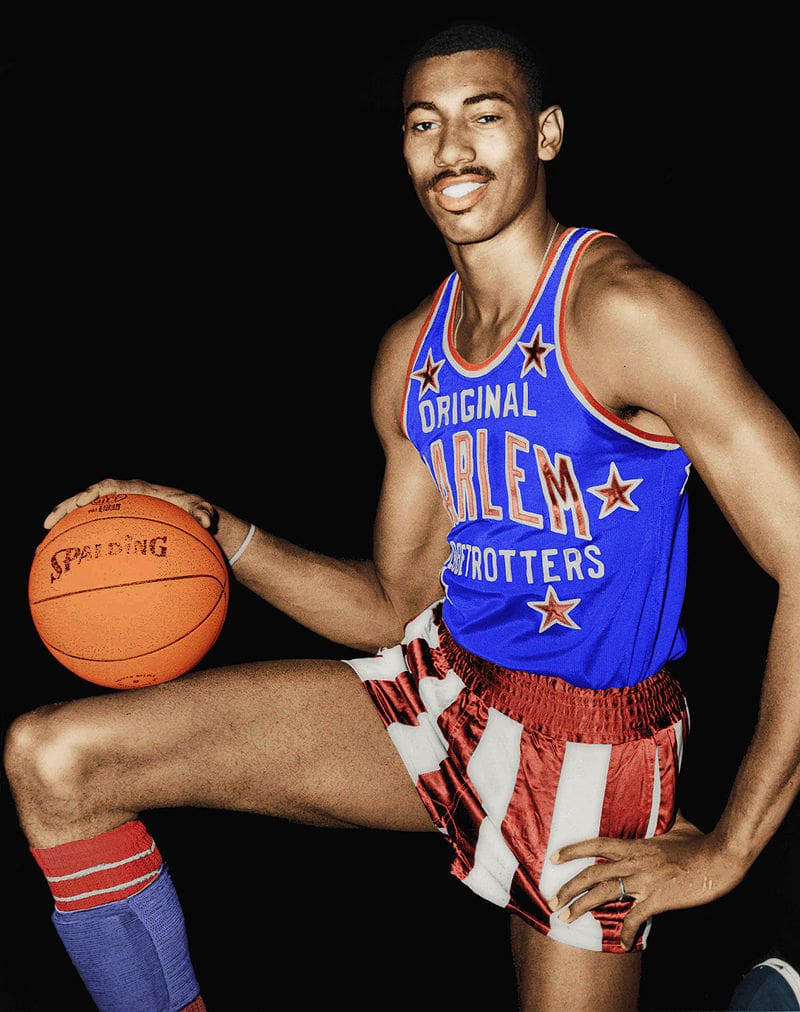
Wilt Chamberlain was one of the most dominant players in basketball history. Playing in the NBA during the 1960s and early 1970s, he was known for his incredible size, strength, and scoring ability. Chamberlain famously scored 100 points in a single game, a record that still stands today. Over his career, he won four Most Valuable Player (MVP) awards, highlighting his impact on the game. He also led the league in scoring and rebounding multiple times. His rivalry with Bill Russell defined an era, and his legacy remains unmatched.
Image: Wilt Chamberlain wearing uniform of Harlem Globetrotters
The chart shows a clear shift in NBA MVP voting by position over time. In the league’s early decades, centers overwhelmingly dominated the award, winning 8 MVPs in the 1960s and 9 in the 1970s. This reflected an era in which teams were built around dominant big men who controlled scoring, rebounding, and defense near the basket. Power forwards, point guards, and wings were far less represented.
Beginning in the 1980s and especially after the 1990s, MVP winners became much more evenly distributed across positions. A major factor behind this change was the introduction of the three-point arc in 1979–80. Although it took time to influence playing styles, the three-point line gradually increased the value of perimeter shooting, ball handling, and floor spacing. As offenses expanded beyond the paint, guards and wings gained greater opportunities to impact games and accumulate MVP-caliber statistics.
The 2000s and 2010s saw point guards, shooting guards, small forwards, and power forwards regularly win MVP awards, illustrating the NBA’s evolution from a center-dominated league to one emphasizing versatility, perimeter play, and shooting efficiency.

Michael Jordan is widely regarded as one of the greatest basketball players of all time and was the defining star of the NBA during the 1990s. Winning five MVP awards and leading the Chicago Bulls to six championships, Jordan combined elite scoring, athleticism, defense, and competitiveness in a way few players have matched. His rise also coincided with a major shift in basketball. Earlier decades had been dominated by centers such as Bill Russell, Wilt Chamberlain, and Kareem Abdul-Jabbar. By contrast, Jordan showed that a perimeter player could become the league’s dominant force. His success reflected the growing importance of guards and wing players in the modern NBA and helped usher in an era where athletic, versatile scorers increasingly replaced traditional centers as the faces of the league.
Image: Michael Jordan dunking ball for Chicago Bulls
The chart shows how quickly African American players came to dominate the NBA MVP award after the league’s early years. Although the first two MVPs were won by white Americans, black American players soon became the dominant force in professional basketball. By the 1950s and especially the 1960s onward, most MVP winners were African American, reflecting both the growing integration of the NBA and the extraordinary influence of players such as Bill Russell, Wilt Chamberlain, Michael Jordan and Magic Johnson.
What has changed more dramatically in recent decades is the rise of non-American MVPs. Earlier NBA history was overwhelmingly dominated by American-born players, but globalization transformed the league. International scouting, overseas development systems, and the NBA’s expanding global popularity produced elite stars from Europe, Africa, and elsewhere. Recent MVP winners such as Nikola Jokić, Giannis Antetokounmpo, and Joel Embiid illustrate how international talent now plays a central role in the NBA’s highest individual honor.

Larry Bird was one of the greatest players in NBA history and a key figure for the Boston Celtics during the 1980s. Known for his shooting, passing, and basketball IQ, Bird led his team to multiple championships. He won three consecutive Most Valuable Player (MVP) awards from 1984 to 1986, a rare achievement. Bird is also notable as one of the few white players to win multiple MVPs in the modern NBA era. His intense rivalry with Magic Johnson helped define a golden age of basketball and elevate the league’s popularity worldwide.
Image: Larry Bird playing for Indiana State University Sycamores
This chart highlights the surprisingly wide geographic spread of NBA MVP winners across the United States, while also showing certain states that have produced an unusually high number of elite players. Louisiana and New York lead the list, followed closely by California. Louisiana’s presence is especially notable given its relatively small population compared to states like California and New York. The state has produced several legendary players, reflecting the deep basketball culture that exists across parts of the American South.
New York’s strong representation reflects its historic importance in American basketball, particularly through the famous street basketball culture of New York City. California meanwhile benefits from its huge population, strong high school programs, and year-round playing conditions. States such as Kentucky and Ohio also appear prominently despite smaller populations, showing how certain regions have long traditions of developing elite basketball talent. Overall, the chart illustrates how basketball excellence in the United States is concentrated in a number of strong regional talent pipelines.

Bob Pettit was one of the NBA’s first true superstars and a pioneer of the power forward position. Born in Louisiana, he starred for the St. Louis Hawks and became the first player ever to win the NBA MVP award, eventually winning it twice. Pettit was an exceptional scorer and rebounder, leading the Hawks to the 1958 NBA championship, where they defeated the powerful Boston Celtics. He retired with over 20,000 career points, a remarkable achievement for his era. His success helped establish Louisiana as one of the most productive states for future MVP winners and laid the foundation for the modern power forward role in professional basketball.
Image: Bob Petit scoring for the St. Louis Hawks
This chart highlights the remarkable importance of height in basketball, a sport where physical stature provides a much greater advantage than in most other major sports. While elite athletes come in many shapes and sizes in football, soccer, tennis, or baseball, basketball has historically rewarded height because taller players can shoot over defenders, rebound more effectively, and protect the basket. As a result, many NBA MVPs have been seven feet tall or taller.
The list is dominated by legendary centers, including Kareem Abdul-Jabbar, who at 7’2″ remains the tallest player to win multiple MVP awards and holds the record with six MVP trophies. Other giants such as Wilt Chamberlain, Shaquille O’Neal, David Robinson, and Hakeem Olajuwon also used their exceptional size to dominate opponents. However, height alone is not enough. Players such as Dirk Nowitzki and Joel Embiid combined size with outstanding skill, illustrating that the most successful big men possess both physical advantages and elite basketball ability.
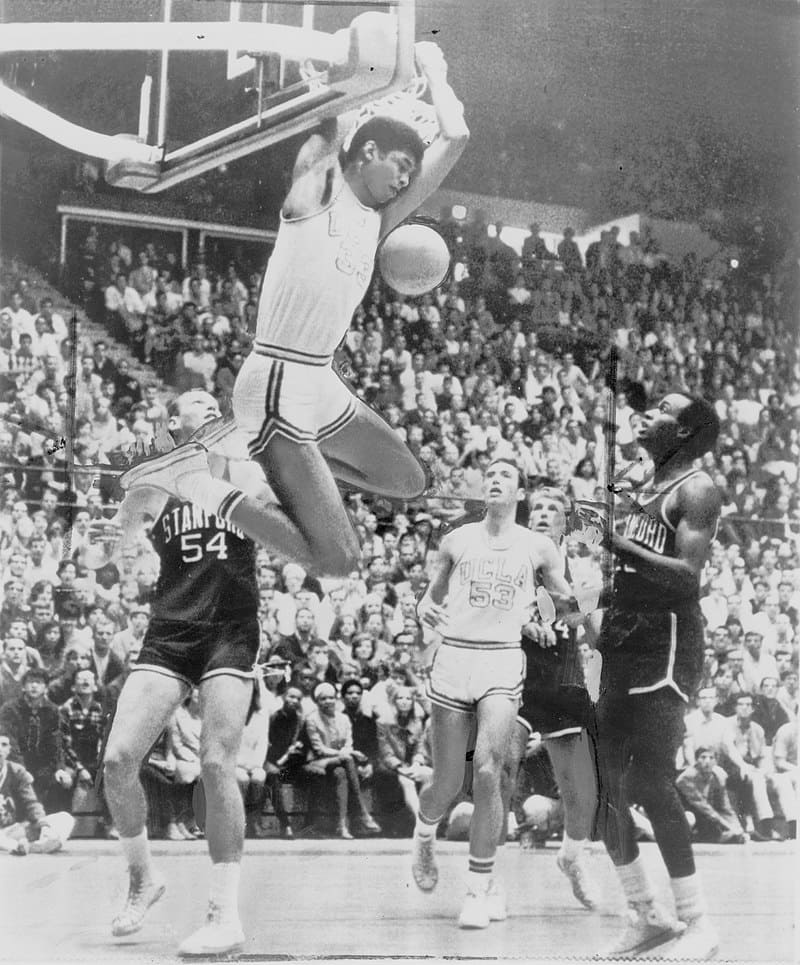
Kareem Abdul-Jabbar is widely regarded as one of the greatest players in basketball history and also the tallest NBA MVP at 7’2. Born in New York City, he dominated the NBA for two decades with his signature skyhook shot. Over his career, he won a record six Most Valuable Player (MVP) awards, more than any other player in league history. Kareem also became the NBA’s all-time leading scorer for many years and won multiple championships with both the Milwaukee Bucks and Los Angeles Lakers. His longevity, skill, and consistency made him one of the most influential and respected figures in the sport.
Image: Kareem Abdul-Jabbar reaching over backwards to score
This chart highlights the players who have won the most NBA MVP awards and the teams with which those awards were earned. Kareem Abdul-Jabbar leads the way with six MVPs, split between the Milwaukee Bucks and Los Angeles Lakers. Michael Jordan follows with five MVPs, all won with the Chicago Bulls, while Bill Russell earned five with the Boston Celtics.
One of the most interesting aspects of the chart is the players who won MVP awards with multiple franchises. Winning MVPs with different teams is particularly meaningful because it demonstrates an ability to adapt to new coaches, teammates, systems, and expectations. Kareem Abdul-Jabbar achieved this with Milwaukee and Los Angeles, while LeBron James won MVPs with both the Cleveland Cavaliers and Miami Heat. Such achievements suggest a player’s greatness transcends a particular environment. By contrast, players such as Jordan, Russell, Larry Bird and Magic Johnson built dynasties with a single franchise, becoming synonymous with their teams and defining entire eras of NBA history.

Bill Russell was one of the most influential players in basketball history and the dominant figure of the NBA’s early decades. Playing for the Boston Celtics, he won an unprecedented 11 NBA championships and five MVP awards between 1956 and 1969. Unlike many superstars, Russell’s greatness was built less on scoring and more on defense, rebounding, leadership, and an unmatched ability to elevate his team. His rivalry with Wilt Chamberlain helped define an era of basketball dominated by centers. Russell was also a pioneering figure off the court, becoming the first Black head coach in major American professional sports. His success established the center position as the most important role in the NBA for many years and left a lasting legacy on both basketball and American society.
Image: Bill Russell during his time at the USF
LeBron James stands clearly at the top of the NBA’s all-time scoring list, with more than 43,000 career regular-season points. His record reflects not only his scoring ability but also extraordinary longevity, having remained an elite player for more than two decades. Kareem Abdul-Jabbar, who held the record for nearly 40 years, remains second with more than 38,000 points, followed by Karl Malone at roughly 37,000.
Kobe Bryant ranks fourth, while Kevin Durant has moved into the top five and could climb further before retiring. Michael Jordan is only sixth despite being widely regarded as one of the greatest scorers ever, partly because he played considerably fewer games than several players above him.
The list demonstrates that career scoring records reward both peak ability and durability. Wilt Chamberlain, Dirk Nowitzki, James Harden and Shaquille O’Neal complete the top ten, representing very different eras and styles of offensive basketball.
.
8. NBA MVPs by Position, Place of Birth, Height and Racial Group
OTHER PAGES ABOUT SPORT
Sources:
NBA MVP & ABA Most Valuable Player Award Winners | Basketball-Reference.com
Image Credits:
Banner Image (Nikola Jokić and Joel Embiid) by Erik Drost – Licensed Under Creative Commons Attribution 2.0
Wilt Chamberlain wearing uniform of Harlem Globetrotters by Fred Palumbo
Michael Jordan dunking ball for Chicago Bulls by Steve Lipofsky – Licensed Under CC BY-SA 3.0
Larry Bird playing for Indiana State University Sycamores by Unknown Author
Bob Petit scoring for the St. Louis Hawks by Unknown author
Kareem Abdul-Jabbar reaching over backwards to score by New York World-Telegram and The Sun
Bill Russell during his time at the USF by Unknown author