
The 21st century has produced some of the greatest attacking footballers in the history of the sport, with elite strikers and forwards achieving remarkable scoring records. Changes in tactics, training and player development have shaped their roles. Lionel Messi and Cristiano Ronaldo have dominated the era, combining exceptional goalscoring with creativity, while other forwards have established themselves through prolific club and international performances. This page examines goals and assists per 90 minutes, outstanding individual seasons, hat-tricks and international goals, alongside the achievements of a selection of leading forwards and the scoring records of the Champions League’s established stars and newer generation.
Statistics
- Goals plus assists per 90 minutes by season: Messi and Ronaldo, 2002/03–2025/26
- Best season goals plus assists per 90 minutes: the original selection through 2018/19
- Players with the most 21st-century hat-tricks: IFFHS ranking, February 2023
- Top 10 men’s international goalscorers of the 21st century
- Goals plus assists per 90 minutes by season: the original 2018-era forward selection
- Champions League career goals: the leading ten
- Leading Champions League scorers in 2025/26
- Champions League appearances needed to reach 50 goals
- Cristiano Ronaldo’s international goals by competition
- International goals per 100 appearances among the leading ten
Goals plus assists per 90 minutes by season: Messi and Ronaldo, 2002/03–2025/26
Lionel Messi and Cristiano Ronaldo developed from gifted young wide players into the defining goalscorers of their generation. Messi’s combination of scoring and creativity generally gives him the higher contribution rate from 2008/09 onwards, although Ronaldo leads in several seasons. Both reached exceptional levels during their years in Spain: Messi’s 2011/12 campaign stands out, while Ronaldo’s strongest rate in this series comes in 2014/15. Their rivalry was sustained by repeated outstanding seasons rather than one brief peak.
The later years are more varied than a simple story of uninterrupted decline. Messi’s first season at Paris Saint-Germain brought a marked fall, followed by a recovery in 2022/23. Ronaldo’s initial Juventus seasons remained productive, but his second spell at Manchester United was less consistent. Both subsequently recorded strong returns outside Europe, with Messi combining goals and assists at Inter Miami and Ronaldo remaining a prolific scorer for Al Nassr. Their longevity remains remarkable, even as their clubs, roles and opponents have changed.
Sources: Messi vs Ronaldo: club-season records and minutes; Provider: assist definitions and source differences; Original page: historical comparison.
Competitive senior club matches; national-team games and friendlies excluded. Rates are recalculated as 90 × (goals + assists) ÷ minutes, using one provider consistently. After Messi moved to MLS, the source aligns his matches with Ronaldo’s European-style season window; these are not complete MLS calendar seasons. Assist definitions differ from Transfermarkt. The ongoing 2026/27 window is excluded. The ZIP includes the underlying goals, assists and minutes for every season.
Argentine forward Lionel Messi is widely considered one of the greatest players of all time. He has won a record eight Ballon d’Or awards. His Barcelona career produced 672 goals in 778 competitive appearances, before spells at Paris Saint-Germain and Inter Miami. His combination of finishing, dribbling and creative passing made him the central figure of one of the club’s most successful eras.
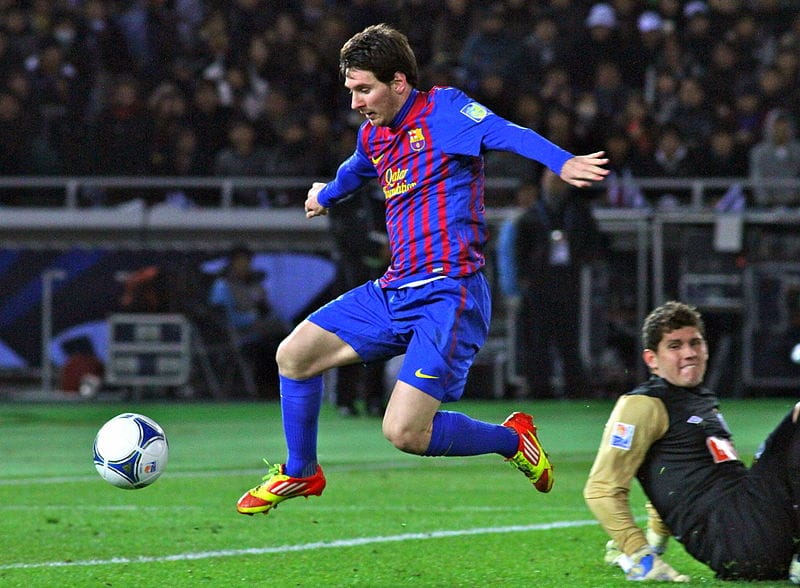
Player record: FC Barcelona.
Best season goals plus assists per 90 minutes: the original selection through 2018/19
Lionel Messi leads the original historical selection with 1.76 goal contributions per 90 minutes, narrowly ahead of Sergio Agüero’s 1.65. Cristiano Ronaldo and Luis Suárez follow at 1.61 and 1.60. These exceptional peaks underline how the leading forwards of the era could combine prolific finishing with substantial creative output. Agüero’s position is particularly striking: his best campaign places him alongside players whose careers accumulated much larger overall totals.
Neymar and Kylian Mbappé also exceed 1.4, while Karim Benzema, Mohamed Salah and Gareth Bale reach at least 1.25. Edinson Cavani, Harry Kane and Robert Lewandowski cluster around 1.2, with Thomas Müller and Mario Mandžukić completing the selection. Their differing positions and responsibilities help explain why a highly influential forward need not lead this particular comparison. The group includes penalty-box finishers, wide attackers and players whose movement creates opportunities for team-mates. Together, their strongest seasons illustrate the extraordinary depth of attacking talent during this period.
Sources: Original page: recovered fourteen-player historical dataset; Original statistical source: Transfermarkt.
Historical comparison, ending in 2018/19; not a ranking of career peaks through 2026. Values are maxima of the retained season table, excluding Mbappé’s erroneous pre-debut 2014/15 cell. The original archive does not provide underlying minutes or a minimum-minutes threshold, and all fourteen-player cells could not be independently re-audited. Its early-career coverage may include reserve or youth records. This source series is kept separate from the newly recalculated Messi–Ronaldo comparison.
Players with the most 21st-century hat-tricks: IFFHS ranking, February 2023
Cristiano Ronaldo and Lionel Messi dominate this IFFHS ranking, with 62 and 56 hat-tricks respectively. Their lead reflects an ability to repeat multi-goal performances over long careers, across domestic competitions and international football. The gap to the rest remains substantial: Ali Ashfaq is third with 35, followed by Robert Lewandowski on 31 and Luis Suárez on 29. The earlier selection overlooked Ashfaq and several other prolific forwards outside Europe’s most widely followed leagues.
Ali Mabkhout and Vyacheslav Zahovaiko each have 26, while Marc Lloyd Williams and Aleksandar Đurić demonstrate the importance of sustained scoring in smaller football markets. Neymar completes the displayed ten with 21. European stars also feature further down the full list, including Zlatan Ibrahimović, Harry Kane, Sergio Agüero and Mario Gómez. Ronaldo and Messi’s totals therefore stand out against a broader international field, rather than just a handful of famous contemporaries. Repeated hat-tricks remain one of the clearest expressions of a striker’s capacity to dominate individual matches.
Sources: IFFHS: worldwide top-level hat-trick ranking, 28 February 2023.
Dated historical snapshot, not a 2026 leaderboard. This was the latest complete worldwide ranking that could be verified for this pack; more recent partial counts are not mixed into it. IFFHS counts games with three or more goals as one hat-trick and covers national leagues, cups, international club matches and national teams. The labels V. Zahovaiko and M. Lloyd Williams abbreviate Vyacheslav Zahovaiko and Marc Lloyd Williams for mobile readability; the CSV contains their full names. Neymar and Sebastián Tagliabúe are tied on 21; IFFHS’s stated tie-breakers place Neymar tenth.
Portuguese forward Cristiano Ronaldo is widely considered one of the greatest players of all time. He has won five Ballon d’Or awards, second only to Messi. During his Real Madrid career he won four Champions League titles and scored 450 goals in 438 competitive appearances. He also won the competition with Manchester United, bringing his career total to five. His years in Madrid established an extraordinary combination of prolific finishing, athleticism and sustained success.
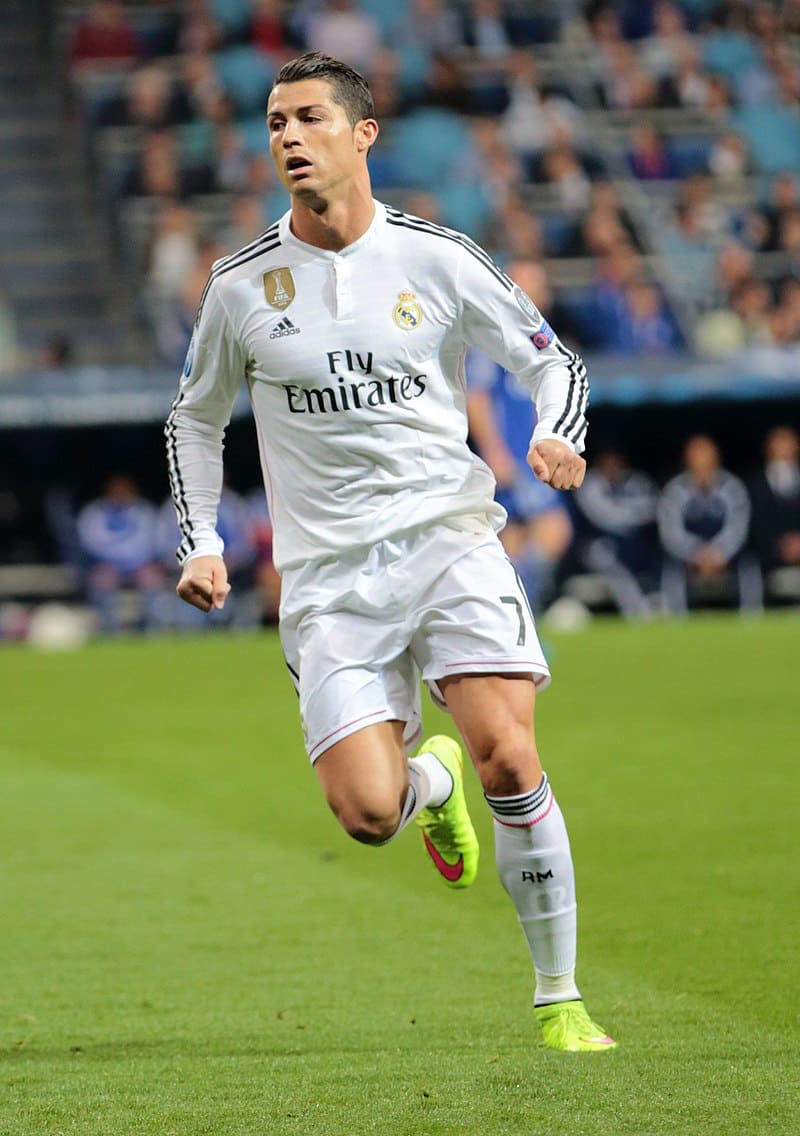
Top 10 men’s international goalscorers of the 21st century
Cristiano Ronaldo remains well clear with 146 international goals, followed by Lionel Messi on 125. Their totals reflect more than two decades as central figures for Portugal and Argentina. Sunil Chhetri follows with 95, while Romelu Lukaku’s 94 and Robert Lewandowski’s 92 underline the importance of prolific national-team forwards across very different football traditions. Harry Kane’s 89 places him ahead of Ali Mabkhout, with Neymar next on 80.
The leading totals combine exceptional scoring with longevity. Ronaldo and Messi have both passed 200 appearances, while Kane has reached his position in considerably fewer matches. Edin Džeko’s 73 and Miroslav Klose’s 71 illustrate the lasting influence of a dependable centre-forward on his national side. Klose’s record belongs entirely to this century, having made his Germany debut in March 2001. Different qualifying schedules and opponents shape the opportunities available to these players, but their sustained importance is unmistakable. Each became a focal point of his country’s attack across successive generations of team-mates.
Sources: UEFA: leading international scorers, data to 5 October 2026; UEFA: European totals and appearances, data to 5 October 2026; FIFA: Neymar’s final international record; FIFA: Klose’s debut and Germany record.
Men’s senior A-internationals, with figures verified against the linked sources on 6 October 2026. UEFA’s latest cut-off is 5 October; Neymar’s final record is 80 goals in 130 appearances. All ten players debuted during this century, so their career totals also equal their post-2000 totals. Earlier-era goals are excluded; Ali Daei’s 108 career goals are not all 21st-century goals. Luis Suárez’s 69 no longer makes this ten-entry selection. Penalty shoot-out conversions are excluded.
Goals plus assists per 90 minutes by season: the original 2018-era forward selection
| Forward | 2002/03 | 2003/04 | 2004/05 | 2005/06 | 2006/07 | 2007/08 | 2008/09 | 2009/10 | 2010/11 | 2011/12 | 2012/13 | 2013/14 | 2014/15 | 2015/16 | 2016/17 | 2017/18 | 2018/19 |
|---|---|---|---|---|---|---|---|---|---|---|---|---|---|---|---|---|---|
| Lionel Messi | — | — | — | 0.76 | 0.65 | 0.94 | 1.3 | 1.21 | 1.51 | 1.76 | 1.66 | 1.32 | 1.53 | 1.36 | 1.42 | 1.27 | 1.65 |
| Cristiano Ronaldo | 0.42 | 0.57 | 0.46 | 0.55 | 0.88 | 1.08 | 0.79 | 1.39 | 1.38 | 1.38 | 1.33 | 1.52 | 1.61 | 1.38 | 1.16 | 1.27 | 1.01 |
| Neymar | — | — | — | — | — | — | 0.94 | 0.87 | 0.81 | 1.03 | — | 0.95 | 1.08 | 1.14 | 1.04 | 1.47 | 1.38 |
| Luis Suárez | — | — | — | — | 0.68 | 0.98 | 1.11 | 1.6 | 0.9 | 0.75 | 1.04 | 1.39 | 1.23 | 1.57 | 1.34 | 1.01 | 0.83 |
| Sergio Agüero | — | — | — | 0.52 | 0.22 | 0.94 | 0.9 | 0.69 | 0.91 | 1.09 | 0.73 | 1.65 | 1.15 | 0.87 | 1.03 | 1.14 | 1.12 |
| Robert Lewandowski | — | — | — | — | — | 0.73 | 0.78 | 0.83 | 0.59 | 0.93 | 1.07 | 0.88 | 0.85 | 1.02 | 1.19 | 1.1 | 1.12 |
| Thomas Müller | — | — | — | — | 0.33 | 0.71 | 0.53 | 0.78 | 0.87 | 0.71 | 1.01 | 1.01 | 0.98 | 1.04 | 0.78 | 0.96 | 0.69 |
| Kylian Mbappé | — | — | — | — | — | — | — | — | — | — | — | — | — | 0.54 | 1.37 | 0.91 | 1.44 |
| Harry Kane | — | — | — | — | — | — | — | 0 | 0.6 | 0.59 | 0.74 | 1.17 | 0.9 | 0.67 | 1.2 | 1.05 | 0.83 |
| Mohamed Salah | — | — | — | — | — | — | — | 0.97 | 0.38 | 0.68 | 0.49 | 0.69 | 0.63 | 0.61 | 0.96 | 1.31 | 0.83 |
| Karim Benzema | — | — | 0.84 | 0.9 | 0.81 | 0.98 | 0.7 | 0.79 | 1.15 | 1.33 | 1.28 | 0.89 | 0.91 | 1.25 | 0.75 | 0.64 | 0.86 |
| Gareth Bale | — | — | — | 0 | 0.41 | 0.44 | 0.13 | 0.46 | 0.59 | 0.73 | 0.95 | 1.11 | 0.65 | 1.25 | 0.7 | 1.07 | 0.69 |
| Mario Mandžukić | — | — | — | — | 0.44 | 0.77 | 0.95 | 0.71 | 0.67 | 0.71 | 0.82 | 0.98 | 0.73 | 0.64 | 0.44 | 0.36 | 0.59 |
| Edinson Cavani | — | — | — | — | 0.79 | 0.25 | 0.51 | 0.54 | 0.94 | 0.8 | 1.03 | 0.82 | 0.72 | 0.77 | 1.2 | 1.16 | 1.2 |
The season records place the peak performances in a wider career context. Messi’s strongest years are spread across much of the 2010s, while Ronaldo’s progress from his early seasons to his Real Madrid peak is especially pronounced. Agüero’s outstanding 2013/14 rate contrasts with several more modest campaigns, showing how injuries, playing time and form can make even an elite striker’s output fluctuate. Suárez’s figures likewise vary between the different phases of his career.
Neymar and Mbappé emerge later in the comparison, joining an established group that also includes Benzema, Salah, Kane and Lewandowski. Müller’s contribution reflects a different attacking role from that of a conventional centre-forward, while Bale combines wide play with decisive scoring. The original selection captures a period when several generations of forwards overlapped at the highest level. Their records demonstrate both extraordinary peaks and the difficulty of reproducing them every season, even for players who remain central to successful teams.
Sources: Original page: recovered season table; Original source: Transfermarkt; France Football: actual 2018 Ballon d’Or ranking; AS Monaco: Mbappé’s December 2015 first-team debut.
The original fourteen-player table is retained as a historical archive for 2002/03–2018/19, with the erroneous Mbappé 2014/15 value removed. Its original “2018 Ballon d’Or nominated forwards” label was inaccurate: Müller and Lewandowski were not nominees, and several actual nominees were absent. The corrected heading preserves the original selection without claiming it is the nominee list. Dashes indicate missing or removed values, not zero contributions. The table’s early-career coverage and remaining legacy cells could not all be independently verified; it is not a newly certified first-team dataset. Swipe horizontally to see later seasons.
Champions League career goals: the leading ten
Cristiano Ronaldo’s 140 Champions League goals remain the leading total, with Lionel Messi next on 129. Their dominance extends beyond domestic football into repeated performances against Europe’s strongest clubs. Robert Lewandowski is the only other player in this comparison above 100, while Karim Benzema’s 90 underline his long importance to Real Madrid. These four forwards helped define successive eras of the competition through both scoring and memorable knockout performances.
Kylian Mbappé has reached 71, level with Raúl, while Erling Haaland’s 59 places another contemporary scorer among the established names. Thomas Müller, Ruud van Nistelrooy and Harry Kane complete the ten. The younger players’ presence marks a generational transition: the benchmarks set by Ronaldo and Messi remain distant, but the chasing group continues to develop. Career totals reward repeated qualification as well as individual finishing. They also reveal how clubs that compete deep into the tournament can provide their leading attackers with years of opportunities to score on Europe’s biggest stage.
Sources: UEFA: Champions League scoring records, 10 September 2026.
UEFA’s published 10 September 2026 snapshot. These are entire Champions League careers, not exclusively goals scored since 2001; several older players began before this century. Qualifying rounds are excluded, avoiding the alternative Ronaldo total of 141. Ties are retained. R. van Nistelrooy means Ruud van Nistelrooy. Ongoing 2026/27 matches after the source cut-off are not added without a consistent updated non-qualifying leaderboard.
Leading Champions League scorers in 2025/26
Kylian Mbappé finished the 2025/26 Champions League with 15 goals, narrowly ahead of Harry Kane’s 14. Mbappé’s tally included 13 in the league phase, giving Real Madrid a remarkable concentration of goals from one forward. Kane’s strong campaign continued into Bayern Munich’s semi-final, illustrating how leading strikers can remain decisive as the competition becomes more demanding. Their close contest puts two established national-team goalscorers at the forefront of the latest completed European club season.
Julián Alvarez, Anthony Gordon and Khvicha Kvaratskhelia each reached ten, bringing three different attacking profiles into the next group. Ousmane Dembélé and Erling Haaland followed with eight apiece. The spread across clubs demonstrates that elite scoring is not confined to the two most familiar modern greats. It also highlights the changing cast of forwards capable of producing major European campaigns. Mbappé’s winning total ranks alongside the outstanding seasons of Lewandowski and Benzema, although Ronaldo’s 17-goal record from 2013/14 remains higher.
Sources: UEFA: final 2025/26 scorers and season records, 30 May 2026.
Completed 2025/26 season, league phase through final; qualifying excluded. All seven players with at least eight goals are shown, including tied totals. No ongoing-season projection is used. The source’s opening final-season tally identifies Mbappé with Real Madrid; a lower historical-season list mistakenly labels his 2025/26 club Paris, which is not repeated here.
Champions League appearances needed to reach 50 goals
Erling Haaland reached 50 Champions League goals in just 49 appearances, setting an exceptional pace. Ruud van Nistelrooy needed 62, while Lionel Messi and Harry Kane each required 66. The comparison highlights the contrast between a prolific specialist arriving ready to score regularly and a young attacker whose responsibilities develop gradually. Haaland’s early impact has made him one of the clearest candidates to challenge the competition’s long-established scoring benchmarks.
Robert Lewandowski and Kylian Mbappé reached the milestone in 77 and 79 appearances, followed by Karim Benzema, Cristiano Ronaldo and Raúl. Ronaldo’s relatively slow route to 50 did not prevent him from becoming the competition’s leading scorer. His progression from a wide role into a relentless goalscorer illustrates why an early scoring rate cannot determine the eventual career total. Kane’s position alongside Messi also emphasises the productivity of a striker whose Champions League debut came later than those of several rivals. Different career pathways can ultimately produce similarly exceptional achievements.
Sources: UEFA: scoring-milestone comparison, 8 September 2026.
Selected players in UEFA’s published comparison, rather than an independently reconstructed exhaustive record list. Group/league phase to final; qualifying excluded. Lower numbers mean the milestone was reached faster. Players who have not reached 50 are omitted, not assigned zero. Tied values are retained. R. van Nistelrooy means Ruud van Nistelrooy.
Cristiano Ronaldo’s international goals by competition
Qualifying competitions account for the largest share of Cristiano Ronaldo’s Portugal goals: 41 in European Championship qualifying and another 41 in World Cup qualifying. Together they contribute 82 of his 146 goals, reflecting his sustained role in helping Portugal reach major tournaments. These campaigns provide repeated scoring opportunities across long international careers, and Ronaldo remained central to Portugal’s attack through successive generations of team-mates.
His contribution also extends well beyond qualifying. Fourteen goals at European Championship finals form a tournament record, while eleven at World Cup finals reflect his scoring across six editions. The Nations League adds 15, with a further two in the Confederations Cup. Friendlies account for 22, leaving 124 in competitive internationals. This distribution shows how the overall record combines routine qualification campaigns with major tournament performances. Ronaldo’s longevity has allowed him to accumulate goals in both established competitions and the Nations League, which arrived well after his international career began.
Sources: UEFA: Ronaldo’s complete international competition breakdown, to 5 October 2026.
The seven categories sum to 146. “Finals” means the final tournament, not only its championship match. The Nations League includes its league phase and finals. Friendly goals count towards senior international totals; shoot-out penalties do not.
International goals per 100 appearances among the leading ten
Ali Mabkhout and Harry Kane lead this group on scoring rate, at approximately 74 and 72 goals per 100 appearances. Romelu Lukaku follows at about 70. Their positions show that the highest career total and the most frequent scoring are different achievements. Cristiano Ronaldo’s world-leading total rests on both prolific finishing and an exceptionally large number of appearances, while Kane has accumulated his goals across a shorter international career.
Neymar, Ronaldo, Lionel Messi and Sunil Chhetri cluster around 60 to 62 goals per 100 matches. Lewandowski, Klose and Džeko have lower rates within this exceptional group, while still holding major national scoring records. A forward’s responsibilities, team strength and opponents all influence how often he finds the net. The broad pattern nevertheless makes clear that there is more than one route to a remarkable international record. Some players stand out through a particularly high scoring frequency; others combine strong output with unusual durability and many years of national-team selection.
Sources: UEFA: leading international scorers, data to 5 October 2026; UEFA: European totals and appearances, data to 5 October 2026; FIFA: Neymar’s final international record; FIFA: Klose’s debut and Germany record.
Derived from the goals and appearances used in the preceding ten-player international ranking: 100 × goals ÷ appearances. This is a per-appearance rate, not a per-90-minute rate, and does not adjust for opponents or playing time. It compares this selected group, not every international forward.
Other pages
- England Football Squads
- Ballon D’Or
- English Premier League
- FIFA World Cup
- Greatest Football Managers
- UEFA Champions League
Sources
- Transfermarkt: original page’s statistical source
- France Football: original 2018 Ballon d’Or ranking
- Messi vs Ronaldo: club-season records and minutes
- Provider: assist definitions and source differences
- Original page: historical comparison
- IFFHS: worldwide top-level hat-trick ranking, 28 February 2023
- UEFA: leading international scorers, data to 5 October 2026
- UEFA: European totals and appearances, data to 5 October 2026
- FIFA: Neymar’s final international record
- FIFA: Klose’s debut and Germany record
- AS Monaco: Mbappé’s December 2015 first-team debut
- UEFA: Champions League scoring records, 10 September 2026
- UEFA: final 2025/26 scorers and season records, 30 May 2026
- UEFA: scoring-milestone comparison, 8 September 2026
- FC Barcelona: Messi’s Barcelona record and eight Ballon d’Or awards
- FIFA: Ronaldo’s Real Madrid record
Updated 6 October 2026. Historical sections retain the explicit date or season window in their headings; newer figures use the source cut-offs shown beneath each chart.
Existing cropped banner: Messi against South Korea at the 2010 World Cup. Photograph by Dundas Football Club. CC BY 2.0. Image source.